Thursday, 30 July 2015

Classrooms as Communities

This post is adapted from a presentation given by myself and my teaching partner Shelagh Saunders in May of 2015 at a Kindergarten Leaders Inspiring Visions of Excellence session.
___________________

Before examining the many benefits of focusing on building a sense of community, I feel it's important to come to a shared understanding of what community means, by hearing from multiple voices.

Webster’s Dictionary defines community as:
1) a group of people living in the same place or having a particular characteristic in common.
2) a feeling of fellowship with others, as a result of sharing common attitudes, interests, and goals.
3) a group of interdependent organisms of different species growing or living together in a specified habitat.

Some of the students in our classroom community last year defined it as:

n  “Community means that we work and play together” – J (SK)
n  “We help other people in need” – D (JK)
n  “We treat others nicely and we listen to our brains so we can make good choices” – V (SK)
n  “In our community it’s important to respect each other” – A (JK)
n  “This community belongs to us because we work together to take care of it” – S (SK)

And lastly, I define it as such:

      A classroom community provides equal voice to all involved – teachers, students, families. Each member’s unique perspective is honoured, valued, celebrated, and reflected in our space. As a learning community, the focus is not on arbitrary rules and discipline, but on co-created expectations, self regulation, teamwork, mutual respect, and accountability. Community members are viewed as confident and capable and are able to gain independence in navigating social interactions with their fellow community members. Time is given to academic learning that occurs in school, but equal time is given to building and maintaining, this community. As a community we talk about our feelings, and as often as we can, we dance, we play, and we laugh.

But why is building community in a classroom so important? For this, I turn to an article by Ellen Booth Church. She eloquently says:

     “We know from recent studies that children who feel a sense of identity within a group are the most well-adjusted and successful in school.  As children progress developmentally, their group interaction skills become more finely tuned as well. Children's "world view" expands to add a greater understanding of the relationship between self and other. Studies also tell us that some of the most important skills children need for school readiness and success are the "people skills" of social interaction, communication, collaboration, and problem solving. That is what you are doing in the first month of school — creating an emotionally secure "home base" for children to learn in” – Ellen Booth Church

In addition to the aforementioned points, I feel that community is important in a classroom as conversations about big ideas such as respect, responsibilities, and roles tend to go hand in hand with community – and this only makes our job easier! When focus is given to building community, students have a vested interest and pride in caring for each other and for the space (i.e. tidy up becomes less about arbitrary rules and more about the responsibility of members within a community). Differences are celebrated. Students feel confidence about who they are as humans and as learners, which trickles down to the “academics”. Students feel valued, safe, and supported. They feel comfortable making mistakes and look at themselves with a growth mindset.

So - given that creating a community within your classroom is so beneficial, how do we go about doing so? I'll now share some specific examples of what we've done in our own experience and how it unfolded in the context of community building.

Practical Considerations for Building Community

The role of the environment:

"It has been said that the environment should act as a kind of aquarium which reflects the ideas, ethics, attitudes and cultures of the people who live in it. This is what we are working toward." - Loris Malaguzzi

In addition to the Reggio Emilia approach, my thoughts about classroom environment have been influenced and shapes by Patricia Tarr's "Consider the Walls". That article is linked at the end of this post, and I highly recommend it. She states:

"The atmosphere created by so many cartoon figures with smiling faces spoke to me about the intended atmosphere for learning. [...] What I saw were cute and trivialized images of children and childhood. The stereotypes images suggested a dumbing down of the environment based on adults' conceptions of what children like." - Patricia Tarr

I interpret this as an important reminder to start the year with your space as a blank canvas, to be filled by the unique individuals that enter your room – this removes ownership of room from solely the teacher(s) and establishes it as a place that belongs to and reflects ALL community members. Students take pride in filling the space with their work, and see relevance of what’s posted, therefore gaining a deeper understanding than they may with store bought posters and cartoon borders that are “just there”. I always like to imagine a student giving a room tour to someone entering our space for the first time. I ask myself – would the student know what everything on the wall is? Would they be able to explain the process behind it? Can they articulate why it’s posted? If not, I consider that time to reflect on what’s up on the classroom walls.

Here are some photographs of letter panels, number panels, and colour word panels that were created by students in our community. We believe (and saw!) a deeper understanding of these concepts when students went through the process of creating them themselves. Students independently knew where in the room to go for anchors when they needed to find a letter, number, or colour word. These panels weren't store bought and slapped up by me in late August - but rather created at the forefront of students' active learning, providing them with a relevant and holistic understanding in a way that they could take ownership of in the end.


The role of the students:

In order for students to feel like valued members of the community, we need to give them the chance to explore skills and knowledge necessary to self regulate. Self regulation is linked to the idea of creating a learning community because it’s rooted in respect and understanding, while valuing where the child may be, rather than where we think they should be or how they should act. It empowers students as functioning members of our communities and removes educators from the role of “policing behaviours”. Students gain a self image of themselves as autonomous members of the community who are able to make decisions based off what they feel/need without a teacher being "the boss".


“…thinking in terms of self-regulation is particularly useful, for it moves us away from seeing the activity as an end in itself – where, for example, the point of the exercise is simply to get children to learn how to sit quietly and listen – to thinking about the underlying capacities that we are hoping to develop.” – Stuart Shanker

In our space, we worked to implement several different tools and strategies, which are visual and tangible reminders for the students to engage in the act of self regulating their emotions, needs, and actions. Some specific examples are below.

We use a rainstick to signify transitions in our community. Students created their own personal rainsticks to take home and continue exploring how they can be used to self regulate.

Students created a community Talking Stick in an effort to create a space where all members felt their voice could be heard.


Our Quiet Corner provides students a quiet and calm place should they need it.
Some documentation found in our Quiet Corner.
  

Rather than a group snack time, we build it in as a learning centre, which encourages students to listen to their own needs and act accordingly.
The Talk It Out Table provides students with a place to work through social conflicts in a respectful and effective way.
Click here to see the blog post detailing the Talk It Out Table.
The Sparkle Jar (adapted from the Minds Up curriculum) provides students with a visual representation of their current energy level or emotional state.


The role of the educators:

So, where do we come in as educators and what can we do to actively shape a sense of community within our classrooms?

To put it simply, we need to make time for community building. Community doesn't build itself. Dedicated time and effort needs to be given not only to build a classroom community, but also to maintain it. I believe that this should be of equal value and importance as academic matters. In fact, at the start of the year, I would argue that this needs to be more important than "getting to the academics". Remember, social learning is an important form of learning, and engaging in "meatier" forms of academics without the basic foundations of a respectful community can be extremely difficult. A huge part of this is recognizing that we as educators aren't the boss or leader of this community, but rather a co-learner positioned alongside the students - and our learning is reciprocal and ongoing.

As the Ontario Kindergarten Curriculum states...

We've implemented a few specific strategies that we feel, in our role as educators but also members of the classroom community, have allowed us to cultivate a growing sense of community amongst the students and ourselves.

As often as possible, we try to provide opportunities to work together on collaborative art projects based on student interest. These projects allow community members to work together towards a common goal by adding their own individual marks. A few of our community's collaborations are pictured below.


We also have dedicated whole group meeting time. Yes, it's known and understood that Kindergarten students benefit greatly from small group learning opportunities, but I feel strongly that also providing whole group experiences as vital in coming together and feeling like a community. We use our talking stick, and once a month provide all community members with the opportunity to discuss what they like about our classroom, but also what they want to see changed. These discussions have been so rich, and giving a voice to ALL community members (not just teachers) about how we set up our space has been eye opening.

Also, and this will come as no surprise to anyone who has visited our space, we have lots and lots of dance parties. On the surface, it looks like just a lot of fun (and it is!) - but it's actually so much more and done for a very purposeful reason with regards to community. These moments of celebration and exploration strengthen the bonds of our community, and provide a joyful moment for all members in which they are free of any expectations or criteria.

It is my hope that you find our specific examples of how we've shifted from looking at our space as a classroom to looking as it a community have been helpful. It seems like a small distinction in words, but hearing students speak about the value of community towards the end of our year together, I knew exactly why it's so important to me. As we look forward to the start of a new school year, I hope to continue considering how to function as a community of learners, and I encourage all educators to do the same.

Lastly, here are a few resources that have been helpful to me in my ongoing learning about cultivating classroom community:

Working In The Reggio Way: A Beginner’s Guide for American Teachers – Julianne P. Wurm

Insights and Inspirations from Reggio Emilia – Lella Gandini, Susan Etheredge, & Lynn T. Hill

Designs for Living and Learning: Transforming Early Childhood Environments – Deb Curtis & Margie Carter
The MindUp Curriculum – The Hawn Foundation
Calm, Alert, and Learning: Classroom Strategies for Self Regulation Stuart Shanker
“Consider the Walls” – Patricia Tarr (https://www.naeyc.org/files/yc/file/200405/ConsidertheWalls.pdf)
“Building Community in the Classroom” – Ellen Booth Church (http://www.scholastic.com/teachers/article/building-community-classroom)

Friday, 26 June 2015

Reflections on a Year: What the Students Taught Me

By nature, educators tend to look at Sept - June as "the year" rather than Jan - Dec. We just can't help it. Also by nature, we tend to spend the final stretch of the school year reflecting on everything that occurred. Of course, we invite students to go through this process - reflecting on their growth, their memories, and their favourite parts - it's kind of an end of year tradition, I think.

Given that I firmly believe in positioning myself as a co-learner alongside the students, I want to devote this end of the school year post to my reflection on what the students taught me this year. Just as they can learn from us, we can (and should!) learn from them. They have a lot to teach, when you pay attention.

So, here are my big takeaways from the school year, thanks to the marvellous and inspiring students in Room 109:

We All Learn in Our Own Ways, In Our Own Time

I've always known this - the idea that development is a continuum in which students travel on their own trajectories, but I feel like I really understood it this year, while seeing the benefits in action. More than ever I challenged myself as a teacher to incorporate a higher amount of small group learning tailored to a more specific range of needs. Once upon a time I may have given all students a similar language task - with all of them working on the exact same criteria - but my students reminded me of the power in turning this idea upside down. From the get go, I witnessed students achieving higher levels of success in our small literacy groups. By paying closer attention to where each student was currently at, my teaching partner and I were able to present students with more individualized tasks that were within their own zone of proximal development. With this, comes not only higher success, but a far greater deal of student pride as students take note of their own mastery - which is a lovely thing to witness and oh so powerful for a Kindergarten's self image. I hope to continue this growth in my own teaching next year by not only having small language groups but also adding small math groups. I thank my students this year for reminding me of the good that can come out of re-framing how we approach group learning in the early years.

Live Without Fear

One of my favourite things about students in Kindergarten is how fearlessly they jump into everything new. While I don't recall my own specific feelings, I imagine walking into a new classroom (and your first classroom, at that!) as a new JK in September must be terrifying. But that's the thing - none of the students seem to be held back by this fear. This year I was so impressed with how the students in our room leapt head first into brand new routines, friendships, learning activities, outdoor experiences, and challenging skills. The idea of living like a Kindergarten student, without fear, really stood out to me this year and directly impacted by own practice in the following way. My teaching partner and I were thrilled this year to be invited to participate in a TDSB initiative called Kindergarten Leaders Inspiring Visions of Excellence (or Kindergarten L.I.V.E.). This incredible program brought together like minded Kindergarten educators to share ideas, develop common beliefs, and to learn from one another. Through Kindergarten L.I.V.E. I was able to welcome other teachers into our room to observe what we do and also presented my first professional development session for other teachers - things I am very proud of this year, and can also honestly say resulted in more self-growth/reflection than I ever thought possible. Yes, along the way, I may have thought once or twice "What if they don't like what I do? What if they disagree with my ideas about teaching?". However, from cues I took directly from the courage shown by the students daily, I pushed those thoughts aside and jumped right in without fear - something I am so, so thankful for after seeing the amount of professional learning that came out of it.

When It Doubt, Dance It Out

"Mr. Seaman, I think we need a dance party". These words, spoken by a JK student, reminded me how important it is to ensure moments of pure joy daily in our classrooms. Yes, students should, and do, work hard in our programs - but it should never be at the expense of their enjoyment. I am a firm believer that above all else (reading levels or amount of known sight words for example) a student should think of school as a positive and happy place. Yes, those other things are important at times, but I believe they don't serve a student nearly as well as a good outlook towards school and learning. For this reason, our class has many, many, many dance parties. Sometimes we just need it. We stop what we're doing, meet on our central community carpet, and shake it to one of many songs (turns out this year my students were big Bob Marley fans! Who knew?). What I thought was so neat this year was how the students took this idea, internalized it, and started to articulate all on their own when they thought we needed to have a dance party. When the aforementioned student said those words (I'll admit it - it was after a whole group math concept - working on this!) I really took it to heart and felt so proud of the student for this important reminder. On one of our last days this year, we had a final dance party together after an absolutely enthralling student led discussion on the feeling of "joy". After dancing our hearts out (thanks for the soundtrack Taylor Swift!), we closed our eyes and tried to describe what the joy felt like inside our bodies. I want to end the post with some of those student responses, since I think more than anything they will stay with me long after this year is gone.

"Joy feels like I am running and running"

"Joy feels like I am in nature and it's quiet and I hear birds"

"Joy feels like a party in my brain"


Thank you students for this year, it's been joyful.

Tuesday, 16 June 2015

The Saga of Captain John's: Embracing a Project Approach in a Reggio Inspired Classroom

As I've mentioned before, the Reggio Emilia approach is so much more than a wicker basket or mason jar here and there. Yes, there is an aesthetic element to the approach - but to simply boil Reggio down to that single attribute glosses over the multitude of brilliant ideas and approaches that are part of this educational philosophy. For me at least, the hallmark of the approach has little to do with aesthetics and much more to do with listening to student interest and using that to guide further learning. More often than not, this tends to unfold in a project approach - and here we find my favourite element of being "Reggio inspired". I want to share a project that's unfolded in our classroom community this year, and use it as a springboard for discussing the benefits of taking a project approach in early childhood learning.

But first, a brief backstory...

Our school is located on Toronto Island - just across Lake Ontario from Toronto's beautiful waterfront. One of our more iconic waterfront landmarks is Captain John's Harbour Boat Restaurant.


Once upon a time it was a beloved dinner outing for families and many Torontonians fondly recall the red velvet interior and luxurious lobster meals. However, after going bankrupt, closing down and falling into dis-repair, the former "floating seafood restaurant" has become notorious for being a bit of an eyesore. Love it or hate it, it's certainly a well known part of Toronto's waterfront. Given that many of our students live in this area, and pass Captain John's daily, it was no surprise that they were all abuzz when it was announced that the boat was going to be towed away from the harbour after being there since 1975.


And this is where our project begins! Here is the initial documentation we tweeted out that describes the project's initial spark:


We were excited to see the new direction students wanted to take at our Dramatic Centre. Later that day, in one of our Learning Centre blocks, we were stunned when a group of students worked together on this incredibly detailed and thoughtful representation of Captain John's using the open ended materials found in our classroom's Art Studio:


Sensing the high level of engagement and interest in this real life event, we provided students additional opportunities through research, collaboration, and critical thinking to consider how we could create a "Captain John's dramatic centre". Some photos of the process are below, along with documented small group conversations. This process was incredibly important (moreso than the product, really) as it allowed students to share and build knowledge. It removed myself and the other classroom educator as "experts" and resulted in the students coming up with their own ideas on how to design and build the boat. Giving the students this independence and ownership over their learning is instrumental in the project approach and results in authenticity in the final work.


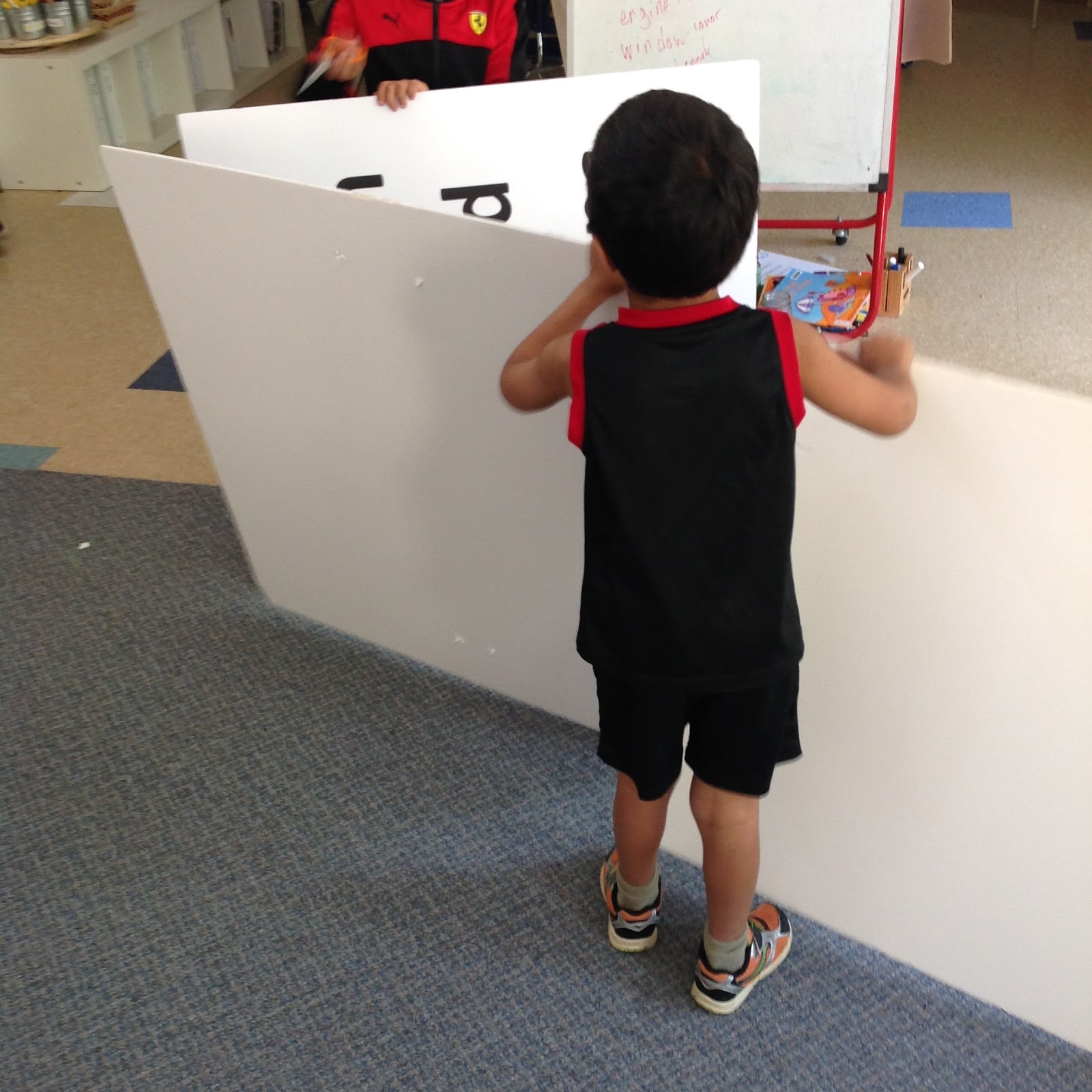
As we continued these conversations and took part in additional research (including a community parent who works on a boat coming in to answer our questions!) we then entered the construction phase, and students chose to use the initial drawing of the boat as a prototype. Using leftover foam core from the school musical as well as cardboard donated from families, our inspired students got to work. Again, throughout this Reggio inspired process, we as teachers positioned ourselves as active participants and co-learners. We were never "in charge" of this process, and were delighted in how so many students let their leadership and teamwork skills shine. As well, we observed all sorts of mathematical conversations and thinking about measurement and spatial reasoning as students went through the process. Another benefit of the project approach is that it allows students to fulfill curricular expectations in meaningful and play-based ways.


(this is one of my favourite shots - a student so engrossed in the project he didn't want to stop for his snack!)

It should also be noted that in a project approach no student is ever forced into it. If Reggio is truly about following student interest, we have to leave room for the fact that not all students may be interested. While many students chose to work together in the ship's creation, several others opted to continue learning at our other play based areas in the room, and we had no problem with this. Again, we strive to keep things authentic at all times. It was neat to observe, however, how the project naturally expanded to involve these other learning centres. A group of students who were not involved in the actual construction decided to use our Writing Centre to create a menu for the restaurant inside the ship. Students used their emerging literacy skills in this exciting extension of the original project and we as educators happily went along with it!


Students worked incredibly hard on every aspect of the project, and as we got closer and closer to completion it was lovely to see the pride students had in their work. I stopped to reflect on the fact that this pride, not to mention all the learning that had taken place, would have been completely missed if this dramatic centre was teacher selected and teacher created.

Today, all the parts were put finally together - and our very own Captain John's floating restaurant officially opened in Room 109. There were customers, chefs, waiters, and yes, even students playing the part of the Captain himself! Excitement was at an all time high, and students took part in dramatic play in an area completely inspired, designed, created, and built by them.


______________

Child-centered practice, hands-on learning, imagination, creativity, collaboration, critical thinking, cross-curricular expectations, authenticity, student ownership, independence, pride, and JOY - this is why I love Reggio and the project approach.


Saturday, 2 May 2015

Our Photography Book Debut: A Project Emerges


Earlier this year, the students in our room transformed our Dramatic Centre into a Photography Studio and used our class iPad to capture stunning, one of a kind images from their unique lens of childhood. The original post detailing how this came to be, my thinking behind it, and what sort of student learning was demonstrated can be found here: The Photography Project: Honouring the Creative Spirit Over Crafts - check it out if you haven't yet! The original post was quite popular and a fair amount of readers asked if the project continued. This post serves as an update of how the interest of student photography has continued to unfold and evolve as the school year progresses.

Initially, the Photography Centre was setup to capture child-initiated self portraits, but as their comfort with the iPad as a camera solidified, we observed students using it to take pictures of each other. Along with this, we continued to explore photography books as a class, searching for inspiration in the art form. This led us to the fantastic book, The Best Part of Me, By Wendy Ewald. Our students connected to this book and couldn't stop talking about the photos and accompanying text. Their interest in delving into a similar exploration was electric.

In partners or groups of 3, they worked together to determine what was their favourite part of themselves. Also choosing a colour background, they had their partner photograph the chosen part, framing the shot as they saw fit. Like the self portrait project, all creative choices were in the hands of the very capable students - we as educators simply stood back and let them be. After this, students were able to use their critical lens in going through all the shots and choosing the one they thought best captured what they wanted to say. Like in The Best Part of Me, students articulated why they chose the part they chose, and this was scribed by myself - reasons ranged from humourous, matter of fact, insightful, and even silly - all of them having the child's voice and personality coming through loud and clear.

As I looked over the work captured through this process, I literally had my breath taken away. The images were stunning in every sense of the word. I knew we had to share them with a larger audience, and with the great Photo Book option on iPhoto, I was able to compile the students work into a beautiful book. Just this week we hosted our families for our official book launch, and I am so happy with how it was received - laughter, tears, and lots and lots of smiles! We also printed each page out and had the student author/photographer sign their autograph to it, which they were able to take home and hopefully frame as a memorable keepsake of what's been a major emerging focus of our year together. Of course, it's not really about the end product, but more so the process and journey that got us here, along with the skills developed along the way.

Funnelling our student interest into this cumulative display has allowed me to present their hard work in a way that I believe honours and celebrates the depth of it. Looking through their photographs again and again, I am continuously wowed by the creative and artistic choices made by these young artists. It's a moment (of many) in which I consider myself very lucky to get to work with these incredible little human beings. I am so very proud of them all.


(parental permission has been obtained to share this image on my blog)

...and because I want to honour their voices as well, here is some documentation from students about this project:


Tuesday, 31 March 2015

The Dangers of Documentation: Ensuring Equity in Your Work

Before I delve into this post, let me emphasize that although I'm referring to the "dangers of documentation", I am by no means against it. In fact, I firmly believe that documentation is a vital part of early learning and is absolutely crucial in capturing the authentic learning that is so very present in play. As educators, we have a responsibility to grab onto these moments, however fleeting they may seem - document, analyze, and share with an audience (be it the child, their family, other students, or other educators). We need to be advocates for the plethora of authentic learning moments that occur, even while others may just see "play". Without documentation, these brilliant moments pass by and are completely lost.

So, now that I've clarified that I am, in fact, an educator who sees the incredible value and importance in documenting, allow me for a moment to examine a pitfall I have unfortunately seen time and time again when documentation loses sight of itself. Like anything I point out on this blog, it's as much a reminder to myself as it is to other educators. I by no means have it "all figured out" and hope this post is a call to arms for all educators, including myself, as we are all still on our unique learning journeys. Anyone who knows me knows that playing Devil's Advocate is a very common thing for me, so this is in no way a critique of how others document, but rather a prompt to look at it from another perspective.

Take a moment and scan your latest few pieces of documentation. Perhaps it's some documentation panels you spent hours putting together, or perhaps it's your Twitter feed filled with daily updates of learning in your classroom. Both are incredible methods and should be present in a balanced program of documentation. As you look over your documentation, ask yourself - "What is being documented?" "Who is being documented?", and "Why is this being documented?".

In an era where we obsessively count our Twitter followers, Instagram likes, and Facebook comments, there's a very real chance that documentation is happening for all the wrong reasons. Again, I don't honestly believe this is the case for most educators, but it is a very real perspective that needs to be addressed.

Are you documenting the work of your scribblers just as much as you are the work of your student who can write full sentences? I would argue that it's our job to document all students equally. No, perhaps the scribbles don't look as "impressive" to other's eyes, but you as the educator know that child's unique journey - perhaps this is their first time gripping a pencil with the pincer grasp, or perhaps this is the first time they willingly choice to independently visit the writing centre. Regardless of the backstory, I think it's important to reflect on equity in our documentation, and remind ourselves that documentation is far more than just what "looks nice". It means documenting the learning of all students we work with. Let's make a pledge to document more - not just what looks the prettiest, may garner the most attention on social media, or looks like traditional "good student work".

On that same concept of equity in our documentation, are the same students showing up time and time again in your documentation? We all know students have a variety of personality traits and some certainly make themselves present more than others in learning experiences, but our job as teachers isn't to just document the students who raise their hands the most, ask the most insightful questions, or come to us to share their learning - it's to document for all. Yes, that means the quiet student who is afraid to speak in class. Yes, that means the child who struggles with the concept being discussed. Yes, that means the child who needs to hear instructions multiple times and still not follow them. We are the teacher for all the students in the room, and if we find ourselves only documenting those who naturally make their learning more visible, I'm not sure we should stop there. Real learning is happening with all students at this age, even if it's not immediately obvious - but look a little closer, dig a little deeper, and it will all become apparent.

Documentation should not be a pat on the back for a teacher. It shouldn't be a "look at all these amazing things in my classroom". It shouldn't be daily updates about only a handful of the "top students" in your class. Yes, there is an element of pride that is important, and we do want to share these awesome moments (and rightfully so!) - but if that's all that's happening, I would argue we may need to reassess why this documentation is happening in the first place and strive to find balance in our work. Documentation, when done thoughtfully, can allow us a thrilling peek into the mind of a child. I find this most interesting when documenting those aforementioned moments that aren't so pretty - the scribbles, the students who rarely speak, the challenging moments and I am trying harder to do this more often in my own practice. Recently I have stopped to remind myself that documentation is so much more than a collection of the greatest moments in your classroom. It's a collection of MANY moments. Varied moments. Great moments, yes, but also challenging moments.  It's something we owe to every child, regardless of where they are at developmentally. When documentation is completed with a lens of equity for all our students, it shows how truly we believe the mantra "all students are capable" - so yes, continue to document those "sentence writing, hand raising, and question asking" students...but also commit to equally documenting the shy ones, the defiant ones, the clumsy ones - you may be surprised what learning was present there all along one you stop to document it.